The guy across from me on the bus wrinkles his nose when I say what I do for a living. “Industrial cleaning? Like… mops and buckets?”
I smile and let him talk. People always picture a lonely janitor in a school hallway, dragging a gray mop behind him for minimum wage.
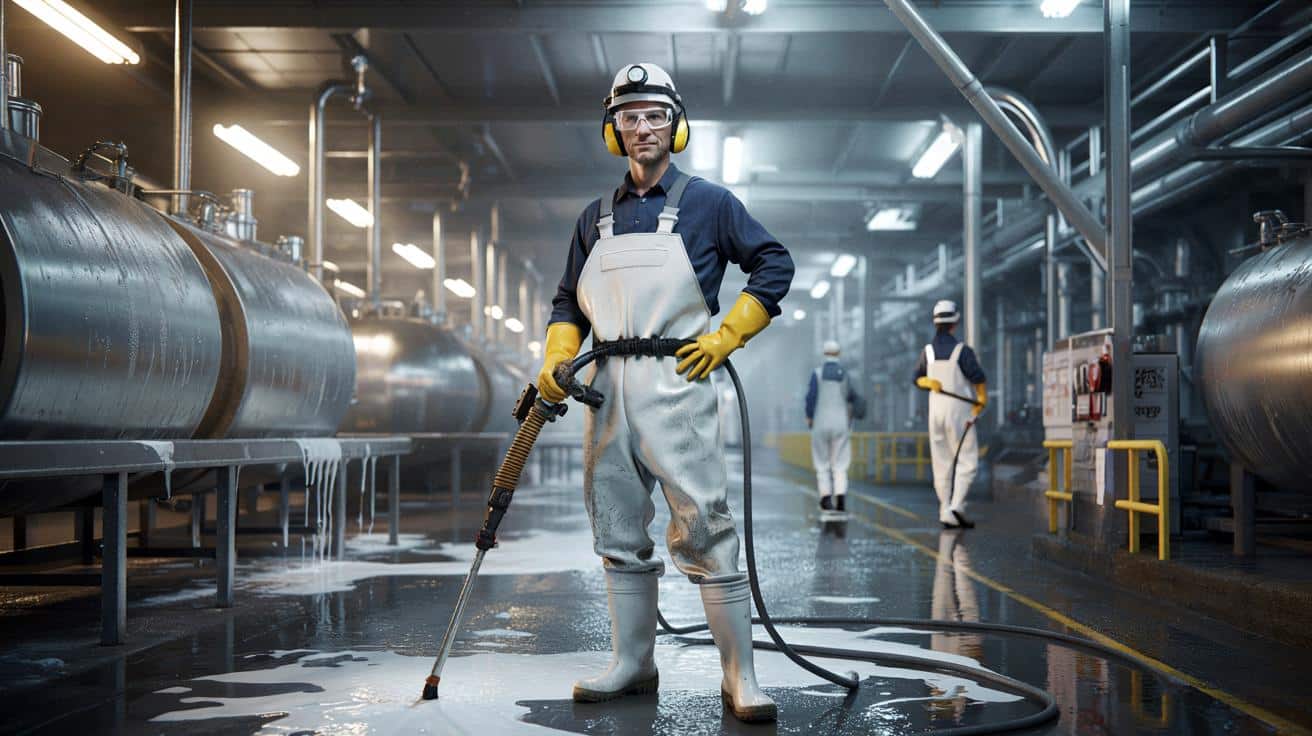
What they don’t picture is me, stepping into a food factory at 10 p.m., helmet and goggles on, and walking past stainless steel machines worth more than a luxury car.
Or the supervisor who quietly told me on my first week: “If you respect the risks and the schedules, this job will pay your rent, your car, and your holidays.”
He was right.
Most people have no idea how much money there is in cleaning what nobody else wants to touch.
And that awkward bus conversation? It almost always ends the same way: with a stunned, “Wait… you earn how much?”
“So, what do you actually do?” – A job people think they know
The funny thing is, everyone thinks they know what cleaning looks like.
Spray, wipe, repeat. End of story.
In industrial cleaning, the story is different.
We walk into massive warehouses, food plants, logistics centers, chemical sites. Machines taller than houses. Pipes running along ceilings. Tanks that once held chemicals, sugar, or animal fat.
The job is part firefighter, part mechanic, part night owl.
The public never sees any of it, because by the time the sun rises, the floors are dry, the machines are shining, and production restarts as if nothing happened.
The only proof we were there is the smell of disinfectant and a signed safety report.
My first “real” night on the job was in a meat processing plant.
We were a team of seven, dressed like astronauts: waterproof suits, face masks, ear protection. The machines were shut down, still warm from the last shift.
The team leader pointed at a massive conveyor. “That one pays your bonus,” he said.
We spent hours dismantling guards, scraping fat, blasting hot water and foam, then disinfecting every surface. At 3 a.m., I was soaked and frozen, and my arms shook from handling a high-pressure lance.
When I got home, I checked my payslip twice. Between night premiums, risk bonuses and overtime, my month’s salary had quietly jumped far beyond what my university friends were earning in office jobs.
That was the night I realised this “basic job” was anything but.
➡️ “I work in quality control and earn $4,750 a month with steady hours”
➡️ How creating financial buffers changes the way you spend
➡️ “I thought rest meant doing nothing”: why that approach didn’t help my recovery
➡️ This subtle adjustment helps conversations flow
➡️ People who feel uneasy during calm weekends often experience this overlooked psychological pattern
➡️ This is why small tasks sometimes feel more exhausting than big ones
➡️ Workers in this role often earn more by specializing narrowly
➡️ This creamy pasta recipe balances cheese and liquid without heaviness
There’s a simple reason the pay is high: most people don’t want to do this work.
They want offices, windows, plants on the desk. Not 2 a.m. inside a tank that smells like bleach and old syrup.
Companies that run 24/7 lines can’t afford contamination, breakdowns, or delays. A few hours of downtime in a factory can cost tens of thousands.
So they pay good money for people who are reliable, trained, and willing to work when everyone else is sleeping.
We’re not talking about a magic jackpot. You start low, like in any job.
Yet between unsocial hours, on-call duties, site bonuses and seniority, the payslip grows quietly, month after month.
How the money really adds up when you clean factories at night
People always ask me the same thing: “Okay, but what do you actually earn?”
The answer depends on the country, the company, the sector.
What surprises them is not the base salary, but everything wrapped around it.
Night shifts, Sundays, public holidays, dangerous sites, high-pressure equipment, confined spaces… each variable has its own bonus.
A “normal” month on a regular schedule might feel average.
Then you hit a stretch of projects with night work and weekend interventions, and suddenly your bank account looks like you secretly changed careers.
*That’s the part nobody sees when they say, ‘It’s just cleaning.’*
Take last winter.
We had a three-week contract in a sugar refinery during maintenance shutdown.
The schedule was brutal: 10 p.m. to 6 a.m., six nights a week.
On top of the base wage, we had night bonuses, weekend bonuses, and a specific risk premium for working at height and around residual dust.
At the end of the month, one of the younger guys, who had joined less than a year earlier, stared at his payslip in the locker room.
He laughed out loud, then showed it to us with wide eyes.
He had earned more in that single month than his cousin, who works as an assistant in an insurance company, makes in three.
Same city, same age, different universe.
It’s not magic.
Industrial cleaning pays because it mixes three things most people avoid: odd hours, physical effort, and perceived “dirty” work.
Companies have to compensate that. They need people who don’t call in sick at the first night shift, who follow safety rules, who can climb a scaffold at 4 a.m. without panicking.
So your value goes beyond “wiping surfaces”.
Let’s be honest: nobody really dreams of cleaning grease out of a deep fryer line at 2 in the morning.
Yet eating safely, driving on clean roads, drinking clean water, all rely on someone doing exactly that.
The economy quietly rewards those who step into that invisible space.
What this job really asks of you (and how to survive it)
If you’re imagining yourself doing this job, start with your body clock.
Can you handle nights, variable shifts, or early mornings without falling apart?
There’s a method to it.
I learned to treat my sleep like a project: dark curtains, phone on airplane mode, no friends dropping by “just for a minute” at noon.
Food becomes strategy too.
Heavy meals between midnight and 4 a.m. will knock you out. Light snacks, water, and a real meal when you get home work better.
You earn money with your hours, but you keep it with your habits.
One season of chaos is manageable, five years of it without structure is another story.
A lot of people burn out in this field not because the work is impossible, but because they live as if their schedule were normal.
They go out after night shifts, skip sleep, eat like they’re on vacation, and then wonder why they’re exhausted.
There’s also a mental side.
Some sites are noisy, some smell bad, some carry real risks. Your brain needs moments of softness: a walk, a series, a coffee in silence.
And then there’s pride.
If you let other people’s judgments creep in (“just a cleaner”), it eats at you.
You start doubting yourself, even as your bank account quietly proves you’re doing something that has solid value.
You’re allowed to say: “Yes, I clean factories. Yes, I’m paid well. Yes, it’s a real career.”
On a break one night, my colleague Nadia said something that stuck with me: “I used to be ashamed to tell people what I do. Now, when I see my rent paid on time and my kids’ savings growing, I just think: someone has to have clean hands, someone has to have a clean conscience. I chose the second one.”
- Pick the right employer
Look for companies that invest in safety training, good equipment, and clear bonus structures. A cheap contractor usually means cheap protection and cheap recognition. - Learn to say “no”
Even with high bonuses, refusing extra shifts when you’re exhausted is not weakness. It’s the only way this work stays sustainable. - Track your bonuses
Many colleagues leave money on the table because they don’t read their payslips. Know which premiums you’re entitled to, and speak up when something is missing. - Invest the difference
Those “crazy” months with huge pay? They disappear fast if you treat them as lottery wins. Use part of them for savings, debt repayment, or training. - Think long term
This job can be a stepping stone to team leader, safety officer, or site manager. The experience you gain around industrial sites opens more doors than you’d think.
Changing how we look at “dirty work” and who deserves a good salary
The funniest reactions I get always come from people who see themselves as “more qualified”.
Office professionals, small managers, sometimes even young graduates drowning in low-paid internships.
They look at my stained boots and assume I’ve failed some invisible exam.
Then they hear about my actual earnings, my paid training, the fact that my company covers certifications most people pay out of pocket.
Something flickers in their eyes.
Not envy, exactly. More like confusion. Like the rules they were taught about “good jobs” and “bad jobs” suddenly stopped working.
We’ve all been there, that moment when you realise the world doesn’t pay people by how “clean” or prestigious their job looks.
It pays for what’s necessary, what’s hard to replace, what few people are willing to do.
Is industrial cleaning glamorous? Not even close.
Do some shifts feel endless, some smells impossible to forget? Yes.
Yet the work is clear. You arrive, you clean, you secure the site, you leave.
You don’t take home an overflowing inbox or vague KPIs. You take home a tired body, a calm mind, and a payslip that quietly contradicts every cliché about “low-skilled work”.
I’m not here to sell this career as a miracle path.
You may hate nights, or noise, or protective suits. You may prefer a clean desk and regular hours, even for less money.
What I wish more people knew is simply this: behind every “simple” job, there’s often a complex reality of skills, constraints, and hidden rewards.
Industrial cleaning just happens to pack all three.
Next time you see someone step out of a plant in a hairnet and rubber boots, don’t assume you know their story.
They might have a better savings account than you. They might be paying off a house. They might be planning a future from inside a job you were taught to look down on.
And quietly, they might be smiling about it.
| Key point | Detail | Value for the reader |
|---|---|---|
| Night and risk bonuses matter | Industrial cleaning adds premiums for nights, weekends, dangerous sites and special tasks | Helps you understand how a “simple” job can reach or exceed many white-collar salaries |
| Habits make the job sustainable | Structured sleep, food, and boundaries protect your health and energy | Shows how to avoid burning out if you enter shift-based or physically demanding work |
| Career paths exist beyond the mop | Experience can lead to team leader, safety, or site management roles | Opens your eyes to long-term opportunities in an often overlooked sector |
FAQ:
- Question 1Can you really earn a good living in industrial cleaning?
Yes. The base wage may look modest, but bonuses for nights, weekends, risk, and specific sites can significantly increase monthly income, especially during intense projects.- Question 2Do you need formal qualifications to start?
Often no, at least not for entry-level roles. Basic education, reliability, and willingness to learn safety procedures are usually enough. Training and certifications often come on the job.- Question 3Is the work physically too hard for most people?
It’s demanding, but not superhuman. The real challenge is consistency: handling shifts, protective gear, and repetitive movements. With time and good habits, most healthy adults adapt.- Question 4Is industrial cleaning dangerous?
There are risks: chemicals, confined spaces, slippery floors, noise. That’s why safety training, protective gear, and strict procedures are non-negotiable. Well-run companies take this very seriously.- Question 5Can this job lead to something “better”?
Yes. Many supervisors, safety officers, and even plant managers started in cleaning or maintenance. Knowing how a site really works from the inside is a powerful advantage later on.