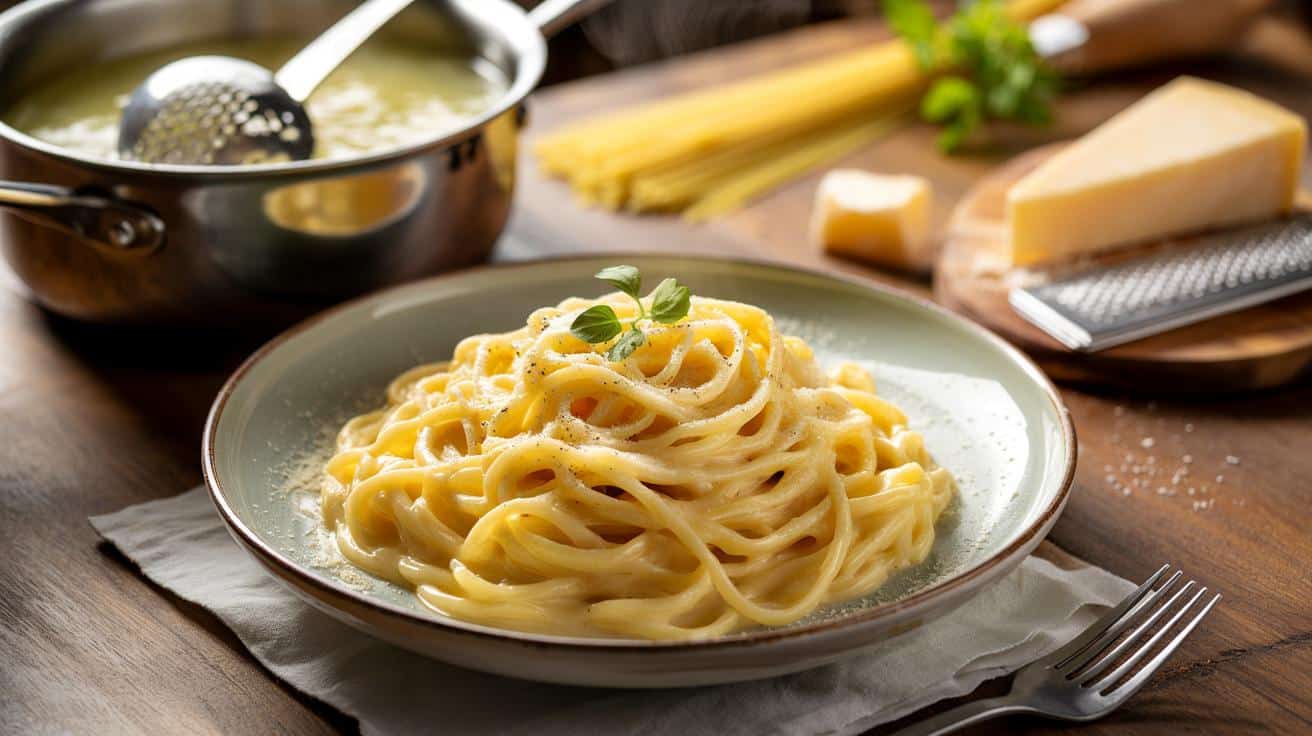
The first time you nail a truly creamy pasta, you know it.
You’re standing over the stove, spoon in hand, watching the sauce cling to each noodle like it was made for it. No oily puddle at the bottom of the bowl, no thick gluey blob stuck to the fork. Just glossy, silky ribbons that taste like comfort but sit in your stomach like a light hug instead of a winter coat.
Most of us don’t get that on the first try. We get the heavy stuff. The “I need to lie down” kind of dinner. And yet, that perfect balance between cheese and liquid is much closer than it seems.
The secret lives in a few tiny, almost invisible choices.
The myth of creamy equals heavy
There’s a particular kind of disappointment that happens at 9 p.m. over a bowl of pasta.
You wanted something cosy, so you threw cream, butter, and a heroic amount of cheese into a pan, stirred bravely, and waited for magic. What you got was a dense, claggy sauce that tasted fine for three bites and then suddenly felt like you’d eaten a weighted blanket.
We quietly blame the recipe, or our pans, or the brand of cheese.
Very rarely do we suspect the real culprit: the ratio.
One home cook I met in a tiny Paris kitchen told me this story. She’d been trying to recreate the cacio e pepe she’d tasted on a trip to Rome. Same cheese, same pasta, she even bought a pepper grinder like the one in the restaurant. Still, at home, her sauce split or turned grainy every single time.
One night, frustrated, she weighed everything. Pasta, water, cheese, even the starchy cooking liquid. She realised she was using almost double the cheese of the Roman restaurant’s proportion. Once she cut it back and added more hot pasta water, the sauce turned shiny and light, almost immediately.
Nothing magical happened. She just stopped drowning the dish in dairy.
That’s the plain truth: most “too heavy” creamy pastas are simply unbalanced formulas.
Cheese is dense and salty, cream is rich and fatty, butter is, well, butter. On their own they taste luxurious, so we assume more must equal better. But a sauce is a system, not a pile. When there’s too much fat and not enough liquid or starch, the cheese can’t melt smoothly into the mix. It clumps, separates, sticks to the pasta in thick patches instead of forming a thin, silky coat.
Balance isn’t about restraint for the sake of it. It’s about giving each ingredient room to do its best work.
➡️ “I thought rest meant doing nothing”: why that approach didn’t help my recovery
➡️ This subtle adjustment helps conversations flow
➡️ Workers in this role often earn more by specializing narrowly
➡️ “I work in industrial cleaning, and the salary is much higher than people expect”
➡️ This is why small tasks sometimes feel more exhausting than big ones
➡️ How creating financial buffers changes the way you spend
➡️ People who feel uneasy during calm weekends often experience this overlooked psychological pattern
➡️ “I work in quality control and earn $4,750 a month with steady hours”
The quiet technique behind a light, creamy sauce
The most reliable method for a creamy pasta that doesn’t feel heavy starts long before the cheese hits the pan.
It begins with the water. Use a smaller pot and less water than you’re used to, so that the pasta water turns very starchy. That starch is your secret thickener, the invisible bridge between cheese and liquid.
Cook the pasta just shy of al dente. In a separate pan, warm a little butter or olive oil with garlic or shallot, then ladle in a small amount of that cloudy pasta water. Turn the heat low. Now add the cheese little by little, off the boil, whisking or shaking the pan so it melts evenly.
Only then do you add the pasta, tossing and adding more water in tiny splashes until it looks loose and glossy.
Most of us, especially on weeknights, do the exact opposite.
We drain all the pasta water, panic, then pour cream straight into a hot pan and dump in a mountain of cheese on full blast. The sauce seizes, thickens too fast, and we chase it with more cream until everything tastes flat and heavy.
We’ve all been there, that moment when you’re stirring and thinking, “This doesn’t look right, but I’ve come too far to turn back.”
The fix is gentler than you’d expect. Lower heat, more starchy water, less cheese at once. And instead of reaching for cream first, think of cheese and pasta water as the main actors, with cream only as a soft background note if you want it.
There’s one habit that quietly ruins many sauces: cooking the cheese.
High heat destroys the delicate emulsion you’re trying to build. The fat separates, the proteins clump, and no amount of stirring will fully save it. For a light creamy texture, you actually want to treat cheese like chocolate. Melt it slowly, in contact with warm liquid, never on a roaring flame.
*“The magic isn’t in the cheese, it’s in how the cheese meets the water,”* a Roman chef once told me, tapping the side of his battered pan.
- Grate the cheese very finely so it melts fast and evenly.
- Keep the pan warm, not screaming hot, when you add dairy or cheese.
- Add pasta water in small splashes, tossing constantly, until the sauce looks slightly too loose.
- Let the sauce rest for 30 seconds before serving so it thickens just enough.
- Use less cheese than you think, taste, then add a final sprinkle on the plate.
A recipe that feels rich but eats light
Once you understand the balance, you can play.
One base recipe looks like this: for 2 people, cook 180 g of pasta in well-salted water. In a pan, melt a small knob of butter with a crushed garlic clove. Add a generous ladle of starchy pasta water and turn the heat low. Off the direct flame, whisk in about 40–50 g of finely grated Parmesan or Pecorino, little by little, turning it into a smooth, loose sauce.
Transfer the almost-al-dente pasta straight into this pan. Toss. Add more hot water in spoonfuls until every strand is slick and shiny, not clumpy. Finish with a splash of lemon juice or extra pepper, maybe a few herbs.
You’ll notice something: the pasta tastes decadent, but you don’t feel weighed down.
| Key point | Detail | Value for the reader |
|---|---|---|
| Use pasta water as your main liquid | Cook pasta in less water so it turns very starchy, then use it to build the sauce | Lighter texture with restaurant-style gloss, without needing heavy cream |
| Control heat and timing | Add cheese off high heat, with warm water, and toss until just coated | Prevents grainy, split or overly thick sauces that feel heavy |
| Cheese-to-pasta ratio | Roughly 20–30 g hard cheese per person, plus a little for serving | Rich flavour and creaminess without post-dinner food fatigue |
FAQ:
- Question 1Can I skip cream completely and still get a creamy sauce?Yes. A mix of finely grated hard cheese and starchy pasta water can create a silky, creamy texture on its own when tossed off the heat.
- Question 2Why does my cheese sometimes turn grainy or clump?Usually the pan is too hot, or the cheese is added too fast and in large chunks. Lower the heat, add cheese gradually, and whisk with warm water.
- Question 3What type of cheese works best for a light creamy pasta?Hard cheeses like Parmesan, Pecorino, or Grana Padano melt smoothly when grated finely. Softer cheeses can be added at the end for flavour, not as the main base.
- Question 4How do I know I’ve added enough liquid?The sauce should look slightly looser than you want in the pan. It thickens quickly as it cools and as the pasta absorbs some of the liquid.
- Question 5Do I really need to measure anything on a weeknight?Let’s be honest: nobody really does this every single day. But having rough ratios in mind – a small handful of cheese per person, plenty of pasta water – keeps your pasta from crossing into heavy territory.