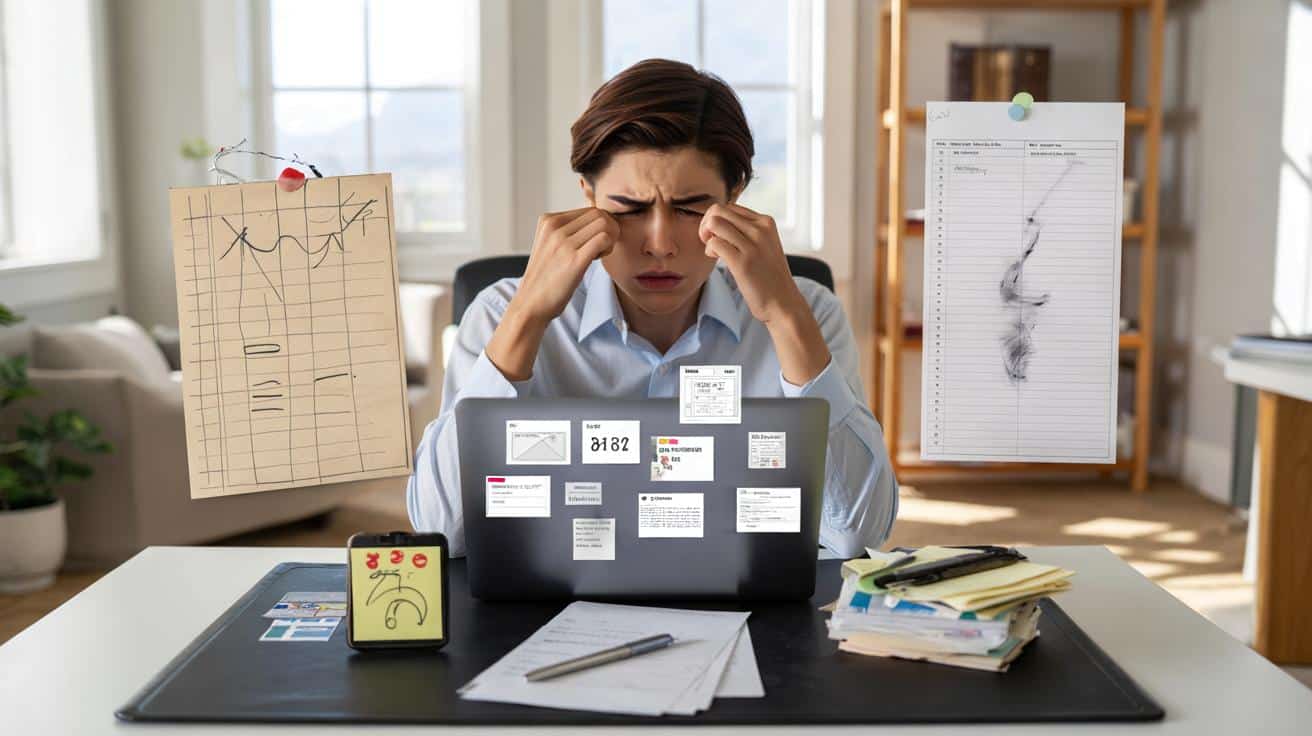
Your to‑do list looks harmless this morning. Answer one email from HR. Book a dentist appointment. Print a form. Nothing dramatic, nothing life-changing. And yet, somehow, you scroll social media for 20 minutes instead, then stare at the wall, then wander to the kitchen just to open the fridge and close it again.
By 11 a.m., you’re not physically tired, but your brain already feels foggy. Strangely, you could probably tackle a full presentation or a complex report more easily than that one annoying call you’ve been avoiding for three days.
Why do the “tiny” things drain us so much?
When little tasks weigh a ton
There’s a name many people give them now: “micro-tasks”. Tiny, simple actions that should take five minutes, yet end up haunting us all week. Reply to that text. Fill out that online form. Send a PDF.
Individually, they look ridiculous. But they pile up in your head like loose pebbles in your shoes. You can still walk, but everything is more uncomfortable, slower, slightly irritating.
The weird part is that your brain doesn’t always rank them by difficulty. It ranks them by how emotionally annoying they feel.
Take Laura, 33, project manager. She can lead a two-hour client meeting without blinking. She can manage a six-figure budget, coordinate ten people, deliver a strategy deck.
Ask her to call the building manager about a broken intercom? She’ll put it off for six days. She’ll feel guilty, glance at the intercom every time she walks past, and each time her shoulders tense up.
When she finally calls, the whole thing takes… three minutes. She hangs up feeling both relieved and slightly angry at herself. “Why did that feel so heavy?” she wonders, half-laughing, half-exhausted.
The first reason: context switching. Your brain doesn’t just do the task. It needs to load the “file” first. Find the number, remember the context, think of what to say, imagine possible outcomes. That’s cognitive fuel burned before you even start.
➡️ People who feel uneasy during calm weekends often experience this overlooked psychological pattern
➡️ “I thought rest meant doing nothing”: why that approach didn’t help my recovery
➡️ How creating financial buffers changes the way you spend
➡️ This subtle adjustment helps conversations flow
➡️ Workers in this role often earn more by specializing narrowly
➡️ This creamy pasta recipe balances cheese and liquid without heaviness
➡️ “I work in quality control and earn $4,750 a month with steady hours”
➡️ “I work in industrial cleaning, and the salary is much higher than people expect”
Second reason: emotional friction. Small tasks often stick to feelings we don’t like—boredom, uncertainty, potential conflict, fear of being judged, money worries. The task is tiny, the emotional charge is not.
Third reason: clutter. Ten small pending tasks create a mental background noise that never stops humming. You’re working, cooking, relaxing, and those “don’t forget to…” whispers keep popping up in the back of your mind. That constant low-level vigilance is what’s so exhausting.
How to trick your brain into moving
One very concrete strategy: turn your micro-tasks into a “power hour”. Instead of sprinkling them across the week, you batch them into a short, focused window.
You sit down, set a 25–45 minute timer, and your only job in that time is to clear as many small tasks as possible. No perfection, no overthinking, just quick execution. Stand up at the end, even if you’re not completely done.
Your brain loves clear edges. There’s a beginning and an end. That turns a vague cloud of dread into a specific, manageable container.
Another trick is to reduce the “activation energy”. If a task starts with a friction point—finding a password, looking up a document, locating a phone number—that’s where your energy leaks.
So, you prep the runway. Save numbers in your phone with clear labels. Keep a simple “admin” folder on your desktop. Write a tiny one-line script for awkward calls like, “Hi, I’m calling because…”
Let’s be honest: nobody really does this every single day. But doing it once a week is enough to change how heavy those small tasks feel. Suddenly, you’re not climbing a cliff, you’re just walking up one step.
Sometimes the task is not hard. What’s hard is crossing the invisible line between thinking about it and actually doing it.
- Use the two-minute ruleIf a task takes less than two minutes, do it the moment you notice it. Answer that text. Forward that email. Toss that receipt. Prevents tiny tasks turning into mental monsters.
- Create a “parking lot” listKeep one visible, simple list just for micro-tasks: admin, calls, forms, quick replies. No big projects there. It’s your “I have 10 minutes and low energy” menu.
- Link micro-tasks to habitsPay one bill after your morning coffee. Send one email right after lunch. Tie them to rhythms you already have, so you don’t rely purely on willpower.
- Celebrate the boring winsCrossing off five tiny tasks can give you a surprisingly big sense of momentum. That feeling spills into the rest of your day.
- Protect your focus blocksDon’t let micro-tasks invade your best brain hours. Keep them in low-energy slots so they stop hijacking your deeper work.
Rethinking what “counts” as real effort
There’s also a quiet, uncomfortable layer behind all this: we tend to underestimate psychological labor. If something doesn’t look visibly hard on the outside, we assume it shouldn’t cost us much inside.
Yet calling a doctor for test results can feel heavier than writing ten emails. Answering a message from someone you’re not fully at ease with can weigh more than finishing a routine report.
We rarely admit it out loud, but mental load isn’t just about time. It’s about emotional exposure, uncertainty, tiny fears that stack up over weeks.
| Key point | Detail | Value for the reader |
|---|---|---|
| Micro-tasks drain hidden energy | They require context switching and carry emotional friction | Helps explain why “easy” things feel so tiring |
| Batching beats sprinkling | Grouping small tasks into short sessions lowers mental noise | Gives a concrete way to regain focus and relief |
| Preparation reduces activation cost | Scripts, organized info, and simple systems smooth the start | Makes it easier to act instead of procrastinate |
FAQ:
- Why do I feel more tired after a day of “just little things”?Because your brain has been switching contexts constantly. Each tiny task asks you to load a different mental file, plus deal with a bit of emotional friction. That adds up to real fatigue, even if you stayed at your desk all day.
- Is this the same as ADHD, or something else?Struggling with small tasks can be part of ADHD, but plenty of people without ADHD experience it too. What you’re feeling might be a mix of executive function fatigue, stress, and the weight of mental load. If it’s extreme or affecting your life deeply, talking to a professional is worth it.
- Why can I do big creative work but not send a simple email?Big creative work can be engaging, rewarding, and more in your “zone”. That email might carry social anxiety, fear of judgment, or just feel boring. Your brain chooses stimulation over discomfort whenever it can.
- Does using apps and to‑do lists really help?They help only if they reduce complexity, not add to it. One short list for micro-tasks, one for bigger projects, and clear time blocks can be useful. *If your system feels heavier than the tasks, it’s time to simplify it.*
- How can I start if I feel totally overwhelmed?Pick one task you can finish in under five minutes and do only that. Then stop. Let your brain feel the small win. Often, that tiny bit of momentum is enough to gently pull you into the next action without forcing it.