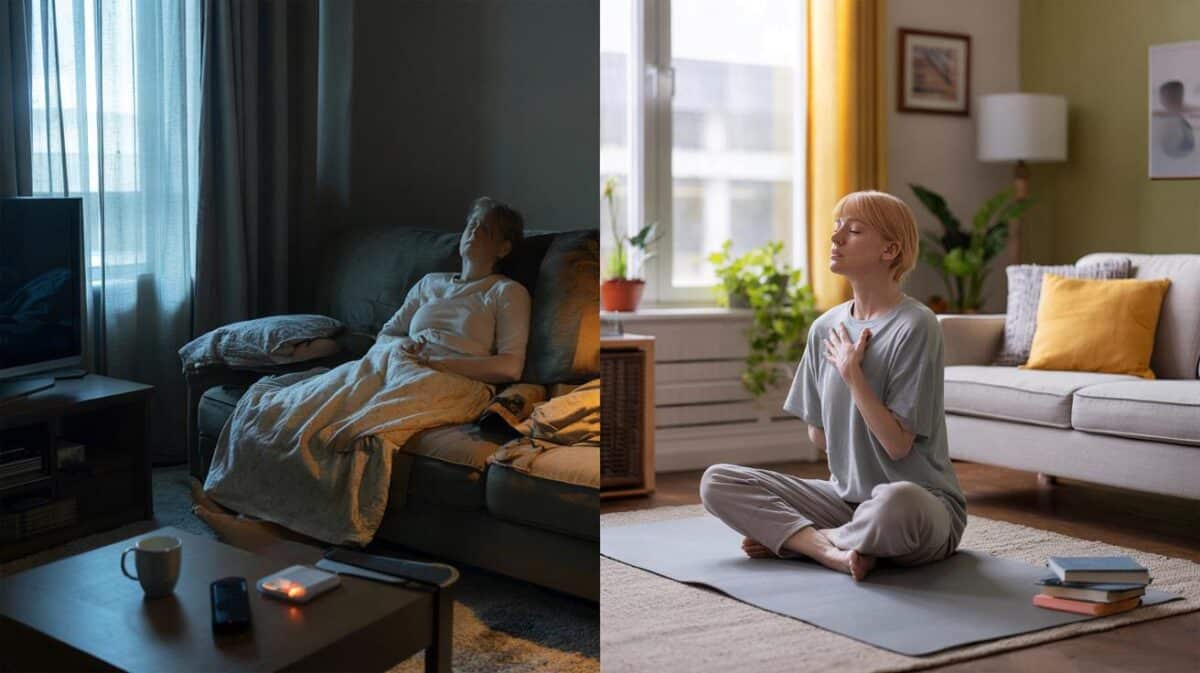
Saturday, 10:17 a.m. The city is quiet in that slightly unreal way, like someone pressed mute on the week. Your phone finally stops buzzing. No meetings. No emails. No one urgently asking for anything. You should feel relief. Freedom. Space.
Instead, a strange restlessness creeps in. Your stomach tightens, your mind starts scanning for something — anything — to do. Netflix feels boring. Reading feels pointless. Even the idea of “just resting” makes you oddly anxious.
You wander from room to room, half-opening apps, half-starting tasks, feeling guilty for not enjoying this precious time off.
There’s a name for this quiet panic that appears when life slows down.
And it says more about you than you might think.
The hidden anxiety of the “too quiet” weekend
Some people wait all week for calm weekends. Others dread them without quite understanding why. The silence of a free Saturday can feel heavier than a full inbox, like the air is thick with a question you can’t answer.
What do I do with myself when nobody needs anything from me?
That unease isn’t random. It often points to an overlooked psychological pattern: you’ve learned to feel safe only when you’re busy, needed, or in motion.
So when life slows down, your nervous system doesn’t read it as “rest”.
It reads it as danger.
Take Lina, 34, project manager, who once told me her worst nightmare wasn’t a Monday morning meeting. It was a Sunday afternoon with “nothing planned”. By noon, she’d have reorganized her kitchen, answered old emails, scrolled through job offers she didn’t want, and still felt like she was failing at something invisible.
The strange part? From the outside, her life looked balanced. Gym on Fridays, drinks with friends, a decent sleep routine.
Inside, every quiet moment turned into a low-grade alarm: “You’re wasting time. You’re not doing enough. Other people are building something while you’re sitting here.”
Her weekends weren’t rest. They were a performance review with no boss in the room.
Psychologists sometimes describe this as a kind of “resting intolerance”. You’ve been trained by life, work, or family patterns to believe that your value comes from output, problem-solving, being *on*. So when there’s no problem to solve, no deadline, no external pressure, your brain goes looking for one.
That’s the overlooked pattern: the nervous system wired for constant alert doesn’t magically power down because the calendar says “weekend”.
It keeps hunting for threats — even if the only “threat” is sitting quietly on the sofa with your own thoughts.
And that discomfort can feel so intense that staying busy starts to look like the safer choice.
How to gently retrain a brain that panics at rest
The shift doesn’t start with forcing yourself to “relax”. That word is too big, too vague, almost aggressive when you’re uneasy with calm. Instead, think in terms of experiments. Small, specific, almost ridiculously simple.
Set a 7-minute timer and choose one low-stakes thing: stare out the window, sip coffee without your phone, lie on the floor and listen to a song from start to finish. That’s it.
When the discomfort rises — the urge to check notifications or get up and do something “productive” — just notice it. Label it in your head: “Ah, here’s that weekend anxiety.”
You’re not failing at rest. You’re just meeting your autopilot.
A common trap is turning rest into a new project to optimize. You create a perfect “self-care” schedule, then feel guilty when you don’t follow it. You judge yourself for scrolling, then judge yourself again for feeling bad about scrolling. It becomes a spiral.
Try a softer approach. Pick one simple ritual for calmer weekends: a slow walk without podcasts, ten minutes with a book, a lazy breakfast with no agenda. And some weekends, you’ll skip it. That’s fine.
Let’s be honest: nobody really does this every single day.
The point isn’t perfection. It’s to show your brain that low-stimulus moments are survivable, even sometimes pleasant.
When therapist clients say, “I feel weird when things are calm,” what they’re really saying is, “My body doesn’t trust peace yet.” That mistrust doesn’t mean you’re broken. It usually means you’ve had to stay alert for too long.
- Notice your first impulse
Is it to grab your phone, open your laptop, start cleaning? That’s often your nervous system dodging stillness. - Create one “buffer activity”
Something gentle between busy and still: stretching, doodling, watering plants. It’s less intense than work, less confronting than silence. - Question the urgent thoughts
When your brain shouts, “You should be doing more,” ask, “Says who? What actually happens if I don’t?” Sometimes the fear shrinks when you look at it directly. - Limit background noise on purpose
One TV-free, podcast-free hour can feel loud at first. Over time, that quiet becomes less like a threat and more like breathable space. - Celebrate tiny wins
Sat on the balcony for 5 minutes without scrolling? That counts. Your nervous system learns through repetition, not grand gestures.
Rethinking what a “good” weekend is supposed to feel like
We’ve been sold two opposite myths about weekends. One says you should be wildly social, productive, squeezing every drop out of your free time. The other shows slow mornings, perfect breakfasts, sunlight on linen sheets, the kind of peace that looks great in a story.
If your reality is somewhere in between — restless, distracted, a bit itchy in your own skin — it can feel like you’re doing life wrong.
Yet this unease is often just information. A quiet signal that your nervous system has only learned one setting: “go”.
And maybe your task now is less about fixing yourself and more about testing new rhythms.
| Key point | Detail | Value for the reader |
|---|---|---|
| Recognizing the pattern | Uneasiness on calm weekends can signal a nervous system wired to feel safe only in busyness | Helps you stop blaming yourself and see the discomfort as a learned response, not a personal flaw |
| Starting with micro-rest | Short, structured moments of low stimulation retrain the brain gently instead of forcing full “relaxation” | Makes rest feel doable, even if you’re uncomfortable with long stretches of free time |
| Redefining a “successful” weekend | Shifting from productivity or aesthetic perfection toward genuine nervous-system calm | Gives you permission to design weekends that actually feel good, not just look good |
FAQ:
- Question 1Why do I feel more anxious on weekends than during busy workdays?
- Question 2Is this the same as workaholism?
- Question 3What if I genuinely hate doing nothing?
- Question 4How long does it take to feel more at ease with calm weekends?
- Question 5Should I talk to a therapist about this feeling?